Global web icon
statology.org
https://www.statology.org/levels-of-measurement-no…
Levels of Measurement: Nominal, Ordinal, Interval and Ratio
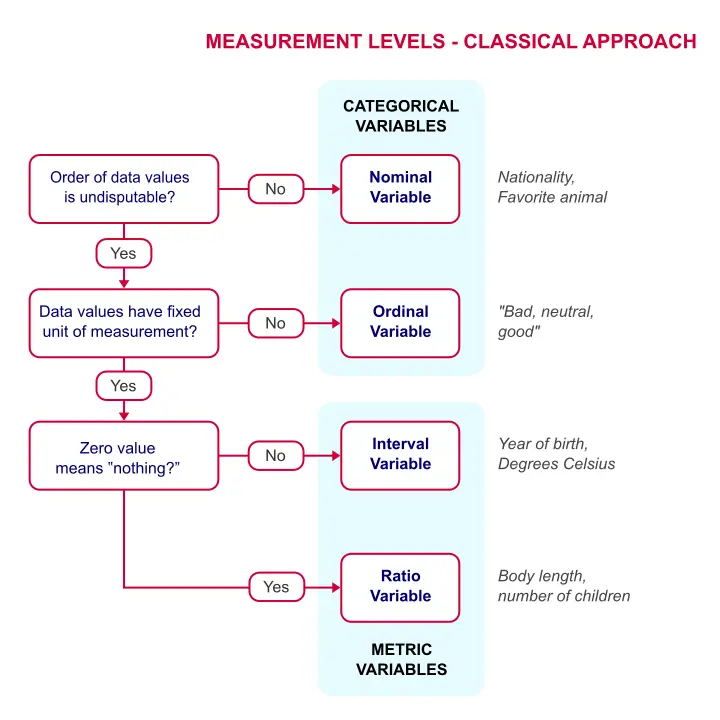
In statistics, we use data to answer interesting questions. But not all data is created equal. There are actually four different data measurement scales that are used to categorize different types of data: 1. Nominal. 2. Ordinal. 3. Interval. 4. Ratio.
Global web icon
libretexts.org
https://stats.libretexts.org/Workbench/Statistics_…
1.4: Levels of Measurement - Statistics LibreTexts
Correct statistical procedures depend on a researcher being familiar with levels of measurement. Not every statistical operation can be used with every set of data. Data can be classified into four levels of measurement which are nominal, ordinal, interval and ratio.
Global web icon
spss-tutorials.com
https://www.spss-tutorials.com/measurement-levels/
Measurement Levels (Statistics) - The Ultimate Guide
Measurement levels classify variables as Nominal, Ordinal, Interval or Ratio. They help us choose the right statistical test and guide our data analysis.
Global web icon
wikipedia.org
https://en.wikipedia.org/wiki/Level_of_measurement
Level of measurement - Wikipedia
Level of measurement or scale of measure is a classification that describes the nature of information within the values assigned to variables. [1] Psychologist Stanley Smith Stevens developed the best-known classification with four levels, or scales, of measurement: nominal, ordinal, interval, and ratio. [1][2] This framework of distinguishing levels of measurement originated in psychology and ...
Global web icon
thedatascientist.com
https://thedatascientist.com/understanding-levels-…
Understanding Levels of Measurement in Statistics: Nominal, Ordinal ...
There are four levels of measurement: nominal, ordinal, interval, and ratio. Knowing about a different level of measurement helps in selecting appropriate statistical tests for your data. It will be essential when presenting or analyzing the results of your statistical investigation.
Global web icon
nu.edu
https://resources.nu.edu/statsresources/measuremen…
LibGuides: Statistics Resources: Levels of Measurement
This guide contains all of the ASC's statistics resources. If you do not see a topic, suggest it through the suggestion box on the Statistics home page. This sub-guide provides you with resources to help you understand levels of measurement and variable types.
Global web icon
statswithr.com
https://www.statswithr.com/foundational-statistics…
Understanding the Levels of Measurement in Statistics
Variables can be measured at different levels, each with its own characteristics and implications for data analysis. These levels of measurement are nominal, ordinal, interval, and ratio. In this post, we will explore each level, what they represent, and how they are used.
Global web icon
w3schools.com
https://www.w3schools.com/statistics/statistics_me…
Statistics - Measurement Levels - W3Schools
Different data types have different measurement levels. Measurement levels are important for what types of statistics can be calculated and how to best present the data.
Global web icon
statisticssolutions.com
https://www.statisticssolutions.com/dissertation-r…
Data Levels of Measurement - Statistics Solutions
A variable has one of four different levels of measurement: Nominal, Ordinal, Interval, or Ratio. (Interval and Ratio variables are sometimes called Continuous or Scale).
Global web icon
statisticseasily.com
https://statisticseasily.com/glossario/what-is-lev…
What is: Levels Of Measurement Explained - statisticseasily.com
In summary, the levels of measurement—nominal, ordinal, interval, and ratio—play a vital role in statistics and data science. Each level has unique characteristics that determine how data can be analyzed and interpreted.