You can use the Advanced Filter dialog box to extract the unique values from a column of data and paste them to a new location. Then you can use the ROWS function to count the number of items in the new range.
The UNIQUE function provides all distinct values in a cell range. Because you don't want to list those uniquevalues, but count them instead, you'll add the COUNTA function.
8 Ways to CountUniqueValues in Microsoft Excel Do you want to count the number of uniquevalues in your Excel data? Knowing the number of unique items in a column when performing data analysis in Excel can provide you with an invaluable overview of your data.
To count unique values in a set of data, you can use the UNIQUE function together with the COUNTA function. In the example shown, the formula in F5 is: =COUNTA (UNIQUE (B5:B16)) which returns 7, since there are seven unique colors in B5:B16.
This article provides a comprehensive guide on how to count distinct Excel pivot table values, use formulas to countuniqueExcel entries and learn Excelcountdistinctvalue features for better data organization.
As such, several methods exist to count the number of uniquevaluesinExcel. This guide will cover them all in detail with easy-to-understand instructions and screenshots.
Are you tired of manually counting the unique and distinct values in your Excel spreadsheet? Don’t worry; there’s a much easier way! In this guide, we’ll show you how to use Excel’s built-in functions to countunique and distinct values. So let’s dive in and learn howtocountuniquevaluesinExcel like a pro! 🥽
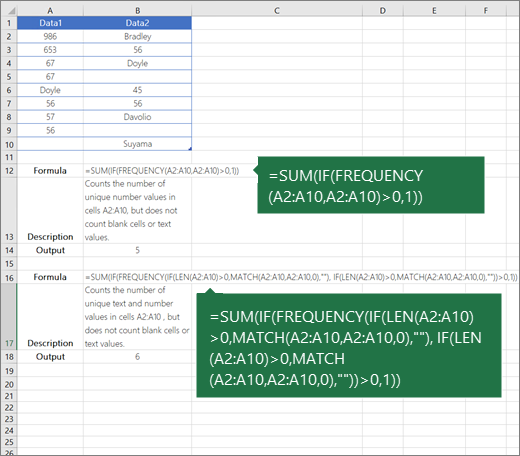 You can use the Advanced Filter dialog box to extract the unique values from a column of data and paste them to a new location. Then you can use the ROWS function to count the number of items in the new range.